
Inertia’s first phase of commercialization is underway. Here are the Top Ten things we’re doing to make star power for life.
Inertia is taking the physics approach demonstrated at Lawrence Livermore National Lab (LLNL), and making it commercially viable for fusion energy. We know that the physics works: the National Ignition Facility (NIF) at LLNL has uniquely and repeatedly demonstrated ignition and energy gain via Laser Indirect Drive (LID), validated by peer-reviewed, published data. The NIF has already tripled the amount of energy gained since the initial ignition event in 2022.
The Lawson criteria is the accepted and objective measure of fusion progress, where a greater triple product of density, temperature, and confinement time indicates progress. This is the well-defined threshold to achieve ignition for any given system. The chart below plots the performance data of each fusion approach to date, showing the decisive results achieved by the NIF’s Laser Indirect Drive approach versus other concepts:
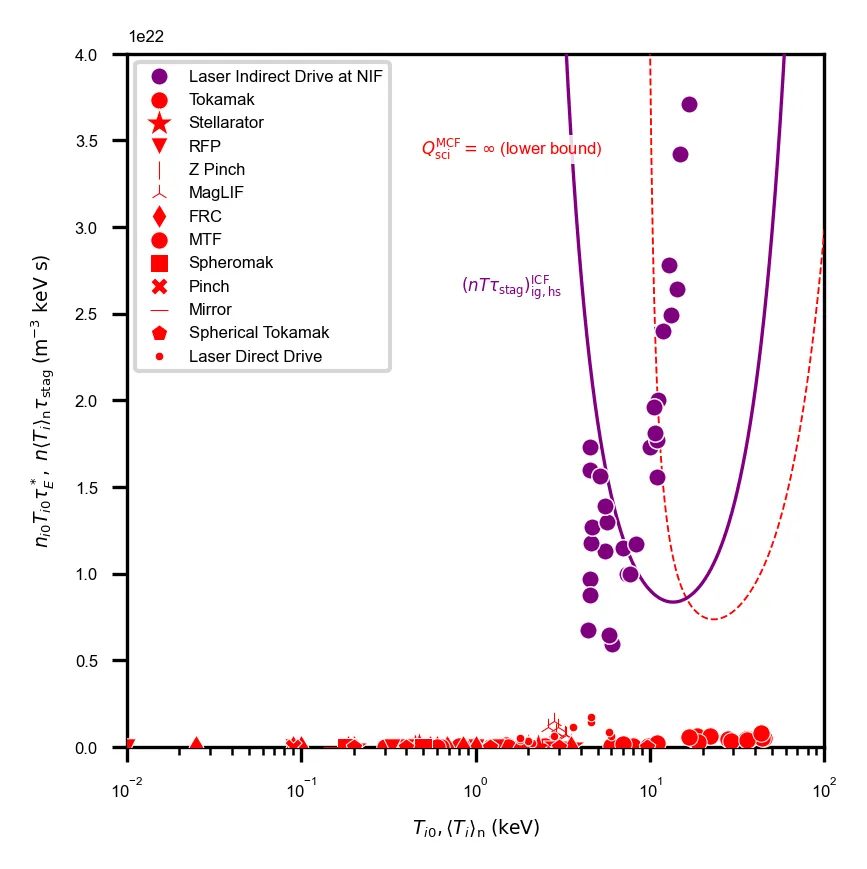
Clearly, the specific regime of physics, Laser Indirect Drive (LID), is now robust and well-established. Other approaches, including other inertial fusion approaches, remain orders of magnitude away from ignition and may never be able to achieve this threshold depending on how the physics of each system behaves. This sets LID apart in both a quantitative and qualitative sense—LID has not only achieved ignition but demonstrated a mastery of the physics by unlocking greater and greater yields. The next step is commercializing this proven result.
Commercialization is a fundamentally different activity than basic science discovery. In scientific discovery, the goal is to test many ideas until you find one that works, proving a hypothesis. In commercialization, the goal is to make that idea work reliably, many times at scale. In science, the goal is not to optimize costs, but to demonstrate physics. In commercialization, the goal is to apply the demonstrated physics to a market that can pay for it. The NIF experiments were never meant to be economical. So the question is, can this proven science be commercialized? Can it be made economical?
To answer this question, we looked at the fusion opportunity through a 2x2 matrix:
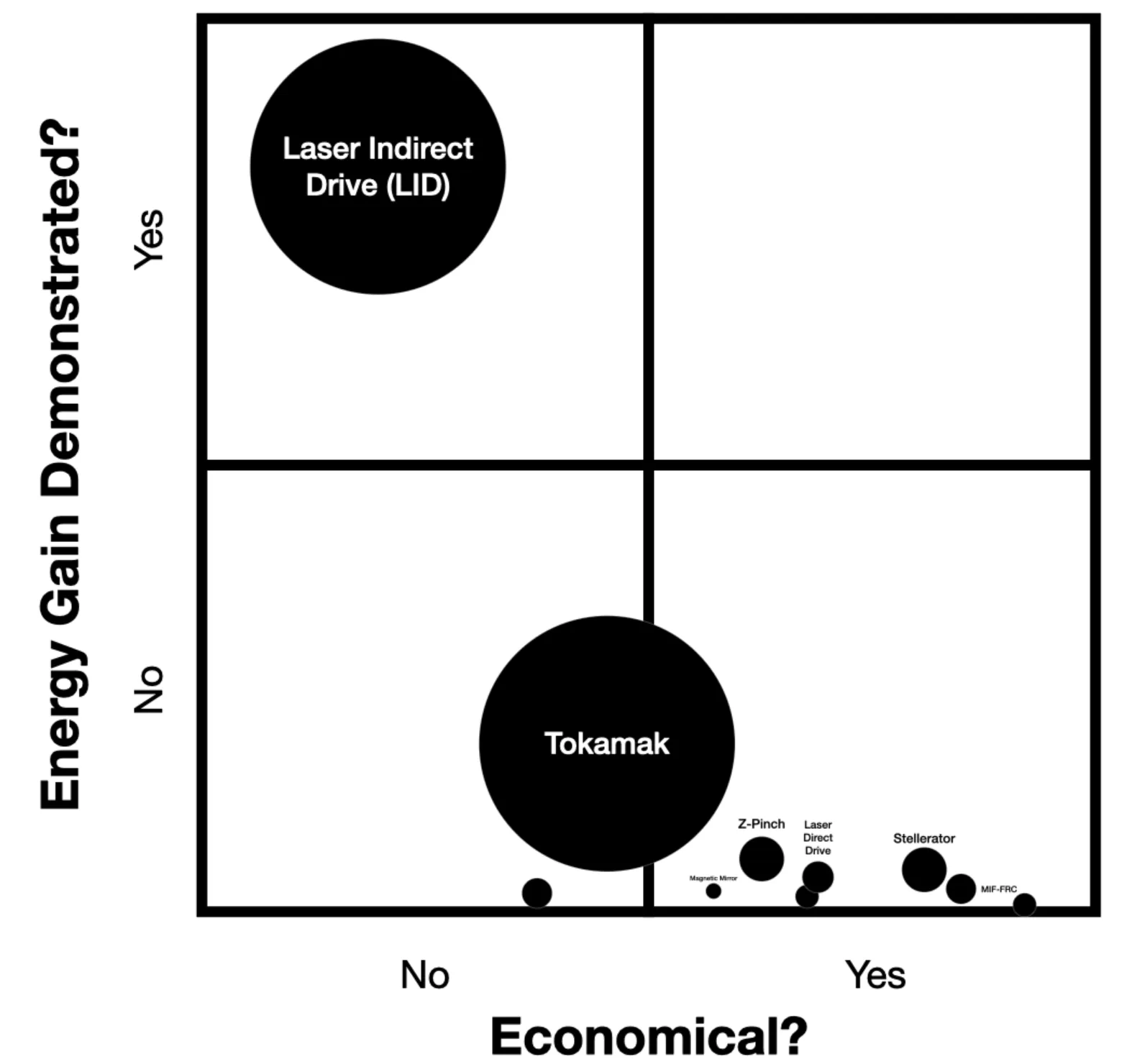
On the vertical axis: Every fusion approach is hopeful that it can ultimately achieve the conditions required for ignition and gain, but other than Laser Indirect Drive (LID), none have yet been proven.
For over 60 years, scientists have regularly predicted ignition and energy gain but failed to achieve it. That’s because their predictions were based on extrapolations of plasma behaviors of lower energy density to the unknowns of higher energy densities. As they built more powerful machines, the results consistently revealed unanticipated physics that invalidated the extrapolations. This cycle has repeated itself many times in the history of fusion. The lesson learned: until you achieve ignition, you don’t know what obstacles remain in the way. Thus, expectations of ignition are very different from demonstrated results. Even with the NIF, it took 13 years from the end of construction to the achievement of ignition. These are salutary lessons for anyone building a new device.
On the horizontal axis: People have various ideas about the hypothetical economic viability of various fusion regimes. But really these are just hypotheses today, as none of the regimes (other than laser indirect drive) have demonstrated the conditions required for ignition, let alone commercial gain.
Size of Circles: Notably, of all approaches, Laser Indirect Drive and Tokamaks have received roughly two orders of magnitude more investment and research.
In the world of fusion, little is agreed upon. Yet there are two undisputed facts:
- The NIF’s Laser Indirect Drive (LID) approach is the only demonstrated fusion concept.
- The NIF is certainly uneconomical as it stands today.
So, the question we ask ourselves is this:
Which is a more plausible path for a private company to take in the development of economical fusion energy? Taking a presumed economical regime that hasn’t yet worked, and trying to make the physics work? Or taking the working uneconomical regime, and making it economical?
Our founding belief is this:
Making a working fusion regime economical is a more predictable commercial path than making an economical but unproven physics regime work.
And so that belief drives our mission. We exist to move Laser Indirect Drive fusion to the right quadrant: demonstrated and economical.
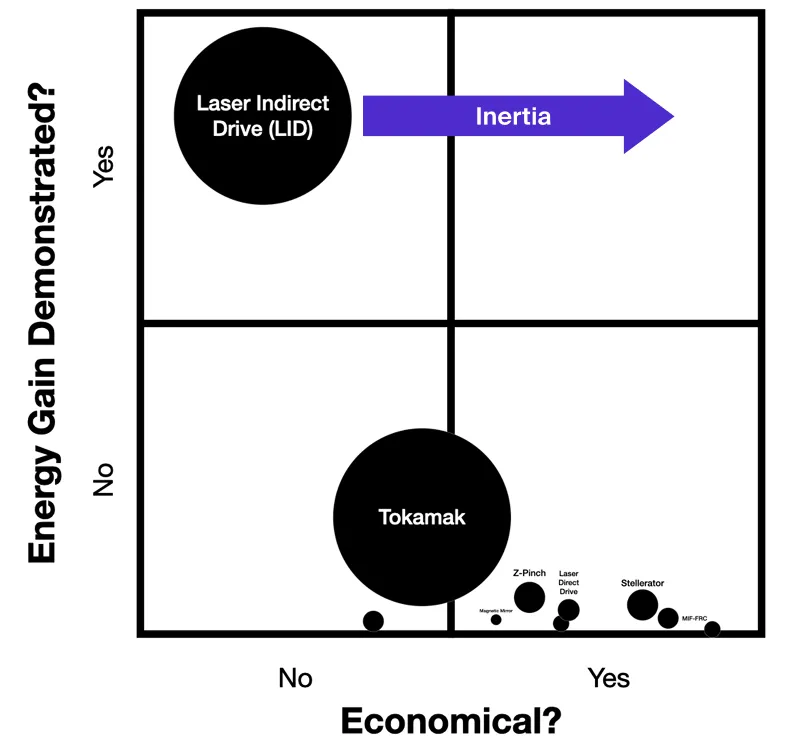
At this phase of Inertia, we are demonstrating that the key components of Laser Indirect Drive can be made to scale economically. Principally, that means:
- We can build a laser system that is powerful, economical, and efficient
- We can mass produce fuel targets that meet the known tolerances to achieve ignition
- Our laser and targets will work together as a power plant to achieve the required gains to generate electricity and close the fuel cycle.
Put simply: our goal is to build Big Lasers and Cheap Targets.
To achieve these three critical things, there are a number of challenges. We have divided Inertia’s execution into four phases:
- Phase I: Component Development: Build the key components of the laser and target manufacturing systems, as part of a self-consistent and integrated design of the power plant.
- Phase II: Subsystem Integration: Integrate the components into fully operational laser and target manufacturing sub-systems, consistent with the integrated power plant design.
- Phase III: End-to-End Integration: Integrate the sub-systems into a first-of-a-kind power plant.
- Phase IV: Deployment: Full commercial rollout of N power plants servicing applicable markets.
These phases are not strictly sequential, but it’s helpful to think of our primary goals in this order. Currently, we are demonstrating that solutions exist for the major sub-systems we need to scale up. And we’re not starting from scratch; the NIF has given us detailed requirements for the laser and target—meaning we can focus our tasks on well-defined, measurable goals.
Below are our Top Ten things we aim to demonstrate in phase one of our development of the world’s first commercially viable fusion power plant. As we demonstrate the component-level solutions, we will move to our next phase wherein we integrate these components into fully operational sub-systems.
Inertia’s Top Ten for Phase I
-
Increase yield to >25x. The hardest part of Laser Indirect Drive fusion is done: proving it’s possible to achieve ignition. This milestone took the US government 60+ years and more than $30B.1 Currently, the target used at NIF generates over 8 MJ of energy per shot. That’s an impressive 4x yield against the 2 MJ that goes in. But for commercial scale, we need to generate enough heat energy from each target shot to power the laser and put a meaningful amount on the grid, all after lossy conversion from heat to electricity. Despite that, our plant’s initial operation requires only 25x target yield to generate 250MW of grid electricity.2 We will demonstrate that we can scale up our target to generate an initial >25x gain for a total of >250 MJ of energy per shot. We will demonstrate this by executing a “Virtual NIF Shot” (referencing the same ICF design codes that LLNL uses to achieve ignition), and demonstrate at the highest possible fidelity that our design, including mass-manufactured targets, preserves the proven physics while scaling to commercially relevant gain.
-
Make laser diodes cheap. The laser at the NIF is impressively large (both in energy and in physical size), but it is very inefficient. It loses ~99.5% of the electricity it draws from the grid, emitting only ~0.5% of that energy as laser light onto the target. Without higher efficiency, generating commercial energy is impossible. While the NIF laser is an engineering marvel, it surprises most people to learn that it is literally powered by gas-filled vacuum tubes (called flash lamps). The key to making a laser that is more powerful, more energetic, more efficient, and more compact is the same transition that’s made every major technology smaller, more powerful, and more efficient: moving from vacuum tubes to semiconductors. Laser diodes are the answer, but as of today, they’re considered cost-prohibitive. That’s because the market for our particular variety of high-power, frequency-tuned laser diodes is currently tiny. But we’re going to change that; the demand for just one of our commercial power plants will need 500 years’ worth of today’s global supply! That means we need to scale up production to meet our anticipated demand. We will (with our industry partners) demonstrate that we can scale up high power laser diode production by several orders of magnitude, and bring the cost down by about 50x from today’s prices. 3
-
Make an efficient and high repetition-rate laser amplifier. The NIF laser is operable for roughly one shot per day, and requires substantial maintenance and cool-down time between shots. For commercial energy, our diode-pumped laser must operate continuously at 10 Hz. Migrating from flash lamps to laser diodes helps enable high repetition rates, but there are many design tradeoffs needed to make the amplifier performant and efficient. We are building a ¼ scale amplifier test stand, demonstrating high-efficiency coupling of diode laser light to the gain medium, while cooling it for continuous operation at 10 shots per second.
-
Make laser optics durable. At Inertia, we will build a laser that is the world’s most energetic (most energy per shot) and the world’s highest average power (100 MW continuous operation). One of the challenges in high-power lasers is finding the sweet spot between making optics large enough to handle all that energy, but small enough to manufacture and handle at scale. The NIF (which was built with optics that were state-of-the-art at the time) intentionally operates above its damage threshold. It was a conscious tradeoff in costs versus longevity—one that won’t work for continuous commercial operation. We will work with industry partners at our in-house optics lab to demonstrate that state-of-the-art optics are durable and economical enough to operate at plant scale.
-
Industrialize carbon shell manufacturing. The fuel targets used by the NIF are made of four main parts: (1) an outer canister (called a hohlraum), (2) a high-density carbon (HDC) shell, (3) frozen deuterium-tritium (DT) fuel inside the shell, and (4) several thin-film tents that hold the shell in place in the hohlraum and seal the hohlraum. In the process of commercialization, we are using this proven design—changing as little as possible—as we cost-effectively scale up manufacturing. Currently at the NIF, these HDC shells take several months to grow and polish in small batches via Chemical Vapor Deposition (CVD). This is a well-known process in manufacturing (widely used in the semiconductor industry), but more typically applied on flat surfaces instead of the round sphere of our target. We are demonstrating that we can scale up fabrication and reduce the cost of these shells through larger batches and shorter cycle times—all while maintaining the required tolerances calibrated on NIF data. We will demonstrate that a scalable CVD process can be applied to meet these properties.
-
Track and hit the targets. At the NIF, the fuel targets are shot one at a time, stationary in the chamber, inserted and aligned using a precision robotic positioning system with detailed manual alignment by a team of technicians. For commercialization, we won’t shoot a single target at a time; we’ll be shooting targets at roughly 10 Hz (10 times per second). This means injecting the target into the chamber at a high velocity and hitting it on the fly with laser beams. (This is similar to how ASML’s EUV lithography system hits injected tin droplets with a laser at 50 kHz.) While this may sound hard, photons are actually very fast compared to matter! But this is a control system that needs to be developed. We will demonstrate that we can track and engage a target moving at the required speed of injection and with the required precision to achieve ignition.
-
Make durable, cheap thin film tents. The carbon shell of a fusion target is held in place by thin films. At the NIF, these films are very thin to ensure they don’t interfere with the fuel implosion. But unlike NIF’s stationary targets, we’ll be injecting the targets at 10 Hz at a high velocity into the chamber. The thin films must be stronger to survive this injection and to endure the high temperature of the fusion chamber. We will demonstrate that economical films exist that are both thin enough to enable ignition and gain, and also strong enough to survive the thermo-mechanical insults 4 of injection.
-
Make target assembly scalable. As mentioned, the NIF targets consist of just four parts. But they must be assembled into a fusion target, including the step of fueling the target with DT fuel. At the NIF, where only a handful of ignition-quality targets are assembled and shot per year, they can be fueled and sealed manually. To achieve commercial scale, we must automate the target assembly. We will demonstrate that a scalable, batch assembly process exists to fill and seal the fusion targets.
-
Fuel targets quickly. At the NIF, fueling the targets is a slow process. It often takes days—and sometimes more than a week—to grow a single pristine DT crystal on the inside of the HDC shell. For commercialization, we need to fuel more quickly and in large batches. That is for efficiency, and also ensures that the amount of tritium in our fueling stage at any one point in time is kept to an acceptable regulatory level. We will demonstrate that a method exists to quickly fuel targets with high-enough ice quality to produce high fusion energy in large batches while keeping low tritium inventory.
-
Integrate everything for a working fusion power plant. The point of commercialization is to eventually produce economical energy (process heat and/or electricity). One of the hard problems in designing a fusion plant is long-term survival of the walls that form the fusion chamber. Inertia’s baseline design uses a simple gas-armored first wall to absorb the bulk of the insult, coupled with low-cost, easily replaced solid walls. This approach doesn’t require a breakthrough in materials science, and crucially, enables low fusion gain, relaxing the requirements on the physics performance. But tradeoffs remain; the larger the chamber, the longer the walls last but the more expensive it is to build. With more beamlines, plant operations become easier, but the plant will breed less tritium. We need to find the optimal solution within the set of tradeoffs. We will demonstrate a self-consistent plant design that utilizes demonstrated physics and incorporates our laser design decisions, target survival decisions, and fuel needs of a sustainable plant.
As Inertia executes our first phase of commercialization, these Top Ten Things will guide us and give us a benchmark for our accomplishments. We’ve chosen these ten things because they’re crucial to driving down the three key economic drivers of our approach: the costs of the laser, the costs of the plant, and the costs of fuel. They’re also the key economic differences between a big science experiment (the NIF) and a commercial operation (what Inertia is building).
It won’t be easy, but we do believe these ten things are achievable. And importantly, they are measurable engineering and supply chain developments—not an exploration of new physics or basic science—making them well-suited for a private company to pursue.
We look forward to updating you on the progress the Inertia team makes—our successes, failures, and the fun along the way—as we bring the world clean, safe, abundant, and economical fusion energy.
Jeff, Mike, and Annie
Footnotes
-
In 2026 dollars ↩
-
For rough calculations, assume an initially 12% efficient 10MJ laser that requires 83 MJ of electricity per shot. Additionally, assume ~45% efficiency conversion from thermal to electrical energy. Thus, gain of 25x on 10MJ energy = 250MJ per shot = 112 MJ of electricity, 83 MJ to power the laser, 5 MJ for other systems, and so 25 MJ for the grid. At 10 Hz, that’s 250 MW power plant. Scaling the Gain to just 40 would net over 900 MWe to the grid, or 1085 MWe with a 15% efficient laser. ↩
-
This is a remarkably similar journey to that seen in other areas of the semiconductor market: from the laser diodes used for face recognition in smart phones, to LIDAR technology for self-driving cars, to the LEDs that light our houses. Each scaled up by many orders of magnitude over the last 20 years, resulting in remarkable cost reductions. ↩
-
We really like the phrase “thermo-mechanical insult” and will use it as often as possible. ↩